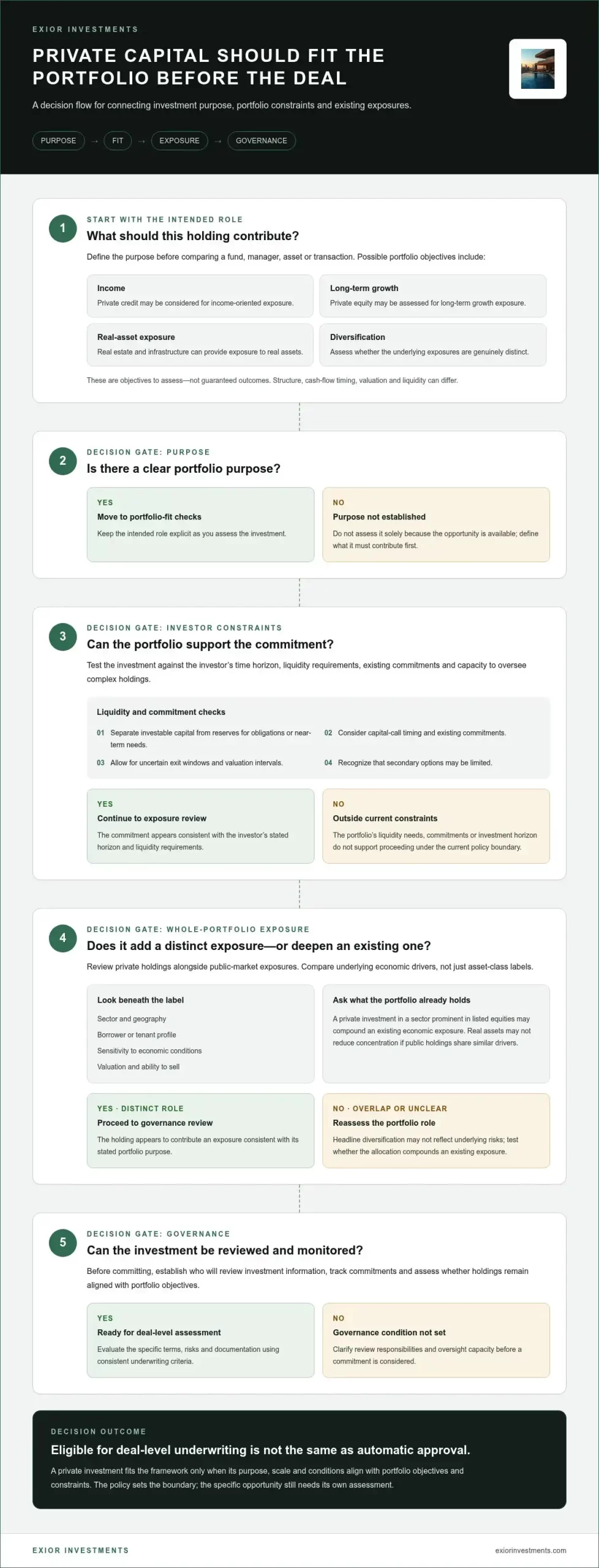
What if the right private investment isn’t the most compelling opportunity, but the one that best fits your portfolio’s purpose and liquidity horizon? A private capital allocation strategy should start there, before individual deals compete for attention.
Private investments can differ sharply in structure, duration, risk, and the information available for assessment. That makes comparisons difficult, while limited liquidity raises the stakes of each commitment. Private capital can support a broader portfolio, but its role, allocation, and review discipline need to be defined in advance.
This 2026 framework shows how to build that discipline. You’ll learn to define private capital’s role alongside existing holdings, assess opportunities using consistent underwriting criteria, and set practical allocation and liquidity rules before committing. We’ll also consider how execution and ongoing review keep investments aligned with portfolio objectives. For investors in the UAE considering private-capital or real-asset opportunities, the principle is clear: allocate by purpose, underwrite consistently, and preserve room to manage existing commitments.
Key Takeaways
- Define the role private investments should play in your broader portfolio before assessing individual opportunities.
- Compare private equity, private credit, real estate, and infrastructure by portfolio purpose, structure, and risk profile.
- Build liquidity planning around capital-call timing, uncertain exit windows, valuation intervals, and limited secondary options.
- Use a private capital allocation strategy with clear objectives, allocation parameters, consistent underwriting, and scheduled reviews.
- Tailored portfolio and real-asset advisory can help connect strategic objectives with deal-by-deal decisions.
What a Private Capital Allocation Strategy Is, and What It Must Achieve
Private capital allocation is a portfolio decision, not a deal decision. It defines the role private investments are intended to play, the scale of exposure the investor can support, and the conditions under which capital may be committed. Set that policy before comparing a specific fund, manager, asset, or transaction.
A private capital allocation strategy is the disciplined process of assigning private investments a defined role, scale, and set of conditions within a portfolio, in line with its objectives and constraints.
Without that framework, a compelling opportunity can look attractive on its own while adding exposure the overall portfolio cannot readily absorb.
Start with the investor’s objectives, time horizon, liquidity requirements, and existing exposures. For example, an investor with substantial exposure to operating businesses may assess a private investment differently from one whose portfolio is concentrated in liquid financial assets. The question isn’t simply whether an opportunity is attractive. It’s whether its role and commitments make sense alongside the rest of the portfolio.
What role can private capital play in a portfolio?
Private capital may be considered for a range of portfolio roles, including income, long-term growth, diversification, or exposure to real assets. These are objectives to assess, not outcomes an asset class can promise. The intended role depends on the investor’s priorities, current holdings, and tolerance for the structure and risks involved. Give each proposed investment a clear portfolio purpose rather than adding it solely because it is available.
Which investor constraints should come first?
Assess the investment horizon, liquidity requirements, existing commitments, and capacity to oversee complex holdings. Separate capital genuinely available for investment from reserves intended for obligations or near-term needs. This distinction matters when capital may be tied up ,or funding commitments may arise on a defined schedule. Suitability is investor-specific; wealth alone doesn’t determine how much private exposure a portfolio can support.
Governance deserves equal attention. Consider who will review investment information, track commitments, and assess whether holdings remain aligned with the portfolio’s objectives. If decision-making involves family members or advisers, clarify responsibilities before committing capital.
The result is a policy boundary, not a predetermined transaction. It establishes what private investments must contribute, what constraints they must respect, and what evidence is needed before a commitment is considered. For investors in the UAE, portfolio advisory and tailored real-asset analysis can help connect those priorities to opportunity-level decisions while keeping the assessment grounded in the investor’s wider position.
How Private Capital Allocation Connects Portfolio Objectives to Asset Roles
Asset-class labels describe what an investment is; they don’t explain why it belongs in a particular portfolio. Allocation should follow the economic role each holding is intended to serve, not the name attached to it. That distinction helps investors compare opportunities by purpose while accounting for differences in cash flows, valuation, and liquidity.
How do private-market asset classes differ in portfolio function?
Private equity may be assessed for long-term growth exposure, while private credit may be considered for income-oriented exposure. Real estate and infrastructure can provide exposure to real assets, but the underlying economics and investment structures vary widely. None of these categories guarantees a particular result.
Structure matters. An equity investment may involve participation in a company’s ownership and value development; a credit investment is shaped by its lending terms and repayment profile. Real-asset investments may provide exposure through different ownership or financing arrangements. Each structure can affect investor control, cash-flow timing, valuation methods, and the potential holding period. These are portfolio-level distinctions, not substitutes for assessing a specific transaction’s terms, risks, and documentation.
How should public and private exposures fit together?
Review private holdings alongside public-market exposures, not in isolation. A private investment in a sector already prominent in listed equities may deepen an existing economic exposure rather than diversify it. Adding real assets won’t necessarily reduce concentration if public holdings already depend on similar economic drivers.
Consider underlying exposures as well as labels: sector, geography, borrower or tenant profile, and sensitivity to economic conditions. Also account for differences in how public and private holdings are valued and how quickly they can be sold. These distinctions can make headline allocations look more diversified than their underlying risks suggest.
A disciplined private capital allocation strategy therefore maps intended roles across the whole portfolio, then tests whether each proposed holding contributes a distinct exposure or compounds an existing one. Investors assessing private and public positions together can use real-asset advisory to bring portfolio objectives into the discussion before moving to opportunity-level analysis.
Does Private Capital’s Illiquidity Make Allocation Too Risky?
Illiquidity is a material constraint, not an automatic reason to exclude private capital. It changes how an investment should be sized, funded, monitored, and integrated with the rest of the portfolio. A private investment may have a stated horizon, but that horizon doesn’t guarantee access to capital at a particular time.
Allocation capacity is determined by liquidity needs and the ability to meet obligations, not by headline return targets. A disciplined private capital allocation strategy must account for the possibility that cash flows arrive later than anticipated or not on the schedule an investor would prefer.
What does private-market illiquidity mean in practice?
Some commitments are funded over time through capital calls, so the investor must be prepared to provide capital when called under the investment terms. Exits and distributions may depend on asset performance, market conditions, and transaction timing. Forecasts can inform planning, but they don’t assure a specific distribution date or exit value.
Valuations may also be updated at intervals rather than continuously. A reported value therefore may not reflect the price or timing achievable in a sale. Secondary transactions can offer a potential route to liquidity, but a buyer, acceptable terms, and timely execution aren’t assured. Plan for the possibility of holding an investment longer than expected.
When can private capital fit an investor’s constraints?
Fit depends on whether the portfolio can sustain both planned commitments and changing circumstances. Before allocating, assess:
- Reserves: Keep liquid assets available for near-term obligations and potential capital calls, distinct from capital intended for long-duration investments.
- Concentration: Review exposure across managers, strategies, structures, and underlying economic drivers. Several holdings can share the same risk even when their labels differ.
- Governance: Determine whether the team has sufficient capacity to review information, track commitments, assess valuations, and make decisions as circumstances evolve.
Private capital may support portfolio objectives through differentiated exposures or access to investment structures that aren’t readily available in public markets. Weigh those potential advantages against cash-flow uncertainty, limited exit options, concentration, and the work required to oversee holdings.
A practical test is to consider a delayed exit alongside an upcoming obligation or capital call. If meeting that obligation would require selling other assets at an unsuitable time, the proposed allocation may exceed the portfolio’s liquidity capacity. The appropriate response may be to adjust the commitment, preserve a larger reserve, or defer the decision. Discipline lies in sizing exposure to what the portfolio can carry, not in assuming liquidity will arrive on schedule.
How to Build a Private Capital Allocation Strategy Step by Step
A workable private capital allocation strategy turns portfolio intent into repeatable decisions. The sequence below creates a policy before approving any individual opportunity.
Define objectives. State what private investments are intended to contribute, such as growth, income, diversification, or real-asset exposure. Set priorities clearly enough to assess whether a proposed investment serves them.
- Map constraints. Record the investment horizon, liquid reserves, near-term obligations, existing commitments, and capacity to monitor holdings. Include relevant public and private exposures so apparent diversification can be tested against underlying concentration.
- Set allocation parameters. Establish exposure limits, concentration considerations, and conditions that require additional diligence or approval. Ranges and scenario analysis can illustrate how the policy responds to different circumstances, but they shouldn’t be treated as suitable percentages for every investor.
- Assess each opportunity. Apply consistent underwriting to the investment thesis, structure, risks, counterparties, cash-flow assumptions, and downside scenarios. Compare assumptions with available evidence, analysis, and appropriate benchmarks.
- Review and update. Schedule reviews and define triggers for reconsideration, such as a material change in liquidity needs, commitments, portfolio exposure, or the investment thesis. A review can test alignment without assuming that a private asset has been continuously repriced.
Which inputs belong in an allocation policy?
Make the policy usable. Document portfolio objectives, reserves, horizon, commitments, and exposure limits, then specify governance responsibilities, approval stages, and documentation expectations. Record the conditions that prompt deeper diligence, including unclear assumptions, concentrated exposure, or a structure that could materially alter cash-flow timing. This creates a clear decision path rather than leaving each opportunity to be judged by a different standard.
How should investors assess and review opportunities?
Keep a decision record for every proposed commitment: the investment thesis, principal downside considerations, liquidity assumptions, and review triggers. Note what evidence supports key assumptions and where uncertainty remains. Periodic reviews should track developments relevant to the thesis, portfolio exposures, and commitments, while recognizing that private valuations may be updated at intervals rather than continuously.
This framework strengthens the quality of opportunity-level decisions without removing investment risk. For investors in the UAE aligning portfolio objectives with private-capital or real-asset opportunities, explore tailored portfolio advisory to structure that analysis around the investor’s broader position.
Putting Private Capital Allocation Into Practice With Tailored Advisory
It clarifies the role an investment is expected to serve, the constraints it must respect, and the questions that need resolution before a commitment is considered. The result is a more coherent process, not a promise of performance.
How can advisory support connect strategy and execution?
Portfolio advisory can help investors frame objectives, existing exposures, liquidity needs, and allocation parameters before reviewing opportunities. This keeps a proposed investment in context: does it advance the portfolio’s purpose, fit within its constraints, and merit further diligence?
Deal-by-deal access lets you consider individual opportunities, but access alone doesn’t establish suitability. Assess each opportunity against the investor’s objectives, risk considerations, liquidity capacity, and existing exposures. Where the thesis involves real assets, real-asset advisory can inform that analysis.
EXIOR Investments provides portfolio advisory, private-capital solutions, deal-by-deal investment access, real-asset advisory, structured finance, and alternative investments. These areas can support a tailored discussion that connects portfolio-level priorities with opportunity-level analysis, without treating any investment as a predetermined fit.
What should an investor prepare before a strategic discussion?
A concise overview can make the conversation more focused. Consider bringing:
- Objectives: The role private investments are intended to play in the broader portfolio.
- Portfolio context: Existing exposures and commitments that may affect concentration or capacity.
- Liquidity requirements: Reserves, anticipated obligations, and the period over which capital may be committed.
- Decision process: Who participates, how approvals are made, and what governance or review arrangements are in place.
- Open questions: Areas requiring further analysis, including structure, downside risks, oversight, and portfolio fit.
This preparation helps distinguish strategic questions from transaction-specific ones. It also gives the investor a clearer basis for assessing whether further diligence is warranted and what evidence would support a decision.
For investors in the UAE refining a private capital allocation strategy, a measured discussion with EXIOR Investments can begin with portfolio objectives and constraints, then consider how relevant private-capital or real-asset analysis may support them. The focus is disciplined assessment and tailored advice, with each opportunity evaluated on its own merits.
Put Your Allocation Framework Into Practice
A disciplined private capital allocation strategy begins with portfolio purpose, not the appeal of a single opportunity. Define the role private investments should play, set allocation parameters around liquidity and existing exposures, and apply consistent underwriting before committing capital.
This structure helps investors assess opportunities on their merits while keeping portfolio fit, downside considerations, and execution in view. EXIOR Investments offers portfolio advisory alongside deal-by-deal access to individual investment opportunities. Its advisory areas also include real assets and structured finance, supporting analysis tailored to the investor’s objectives and portfolio context.
Bring your priorities, existing exposures, liquidity requirements, and open questions into the conversation. Arrange a private discussion with EXIOR Investments to consider how disciplined allocation can inform your next decisions. A clear framework is a strong foundation for investing with greater intention.
Frequently Asked Questions