The Dubai property market 2026 enters a new phase. After several years of exceptional price appreciation, record-breaking transaction volumes, and strong international capital inflows, HNWI investors are asking a more sophisticated question:
Is Dubai still an exceptional investment opportunity—or is selectivity now more important than ever?
The answer lies somewhere in between.
Dubai is still one of the world’s global capital destinations with a tax-free structure and crime-free communities.
Population growth continues, government policies remain HNWI investor-friendly, infrastructure investment is accelerating, and the emirate continues attracting entrepreneurs, family offices, and high-net-worth individuals from across Europe, Asia, Africa, and the Middle East.
However, a strong city does not automatically mean every asset represents a strong investment.
The Dubai real estate forecast 2026 points toward a market becoming increasingly segmented. While premium assets in established locations continue demonstrating resilience, some areas could experience pricing pressure as new inventory enters the market.
For sophisticated investors, the coming 12 to 24 months will likely reward discipline over speculation.
At Exior Investments, we believe objective market interpretation creates better investment outcomes than repeating optimistic headlines. Understanding where opportunity exists—and where risks are increasing—is essential for preserving capital while generating long-term returns.
Understanding the Dubai Property Market 2026
Five major indicators are shaping the Dubai property market 2026:
- Transaction activity
- Property prices
- Rental performance
- Population growth
- Future housing supply
None of these metrics should be viewed independently. Together, they provide a clearer picture of where the market is heading.
Unlike previous cycles driven primarily by speculative demand, today’s market benefits from broader economic fundamentals including business migration, Golden Visa policies, wealth relocation, tourism growth, and continued infrastructure expansion.
Nevertheless, HNWI investors should recognise that markets evolve. Exceptional growth eventually transitions into more normalised performance.
That transition appears to be underway.
Transaction Volume Remains High—but Momentum is Changing
Dubai has consistently recorded one of the highest property transaction volumes in its history over recent years.
This remains a positive signal.
High transaction activity demonstrates liquidity—an important characteristic for institutional investors and international HNWI buyers alike.
However, investors should distinguish between:
- Growing transaction volume
- Accelerating price growth
These are not always the same.
A market can continue recording strong sales while price appreciation moderates.
This is common during mature expansion cycles.
Instead of expecting double-digit annual appreciation across every community, investors should anticipate increasing divergence between premium and average-performing assets.
That makes asset selection considerably more important.
Dubai Property Prices: Growth is Becoming More Selectiv
The conversation surrounding Dubai property prices often focuses on citywide averages.
Professional investors know averages can be misleading.
Certain luxury waterfront communities continue experiencing strong international demand.
Prime branded residences remain relatively insulated because supply remains constrained.
Meanwhile, mid-market developments facing significant incoming inventory may experience slower appreciation.
This does not necessarily indicate market weakness.
Instead, it reflects normalisation.
As markets mature, pricing becomes increasingly driven by:
- Location quality
- Developer reputation
- Building management
- Unit scarcity
- Rental demand
- Future competing supply
The era of nearly every project appreciating rapidly may gradually give way to a market rewarding better investment selection.
Dubai Housing Supply Will Shape the Next Market Cycle
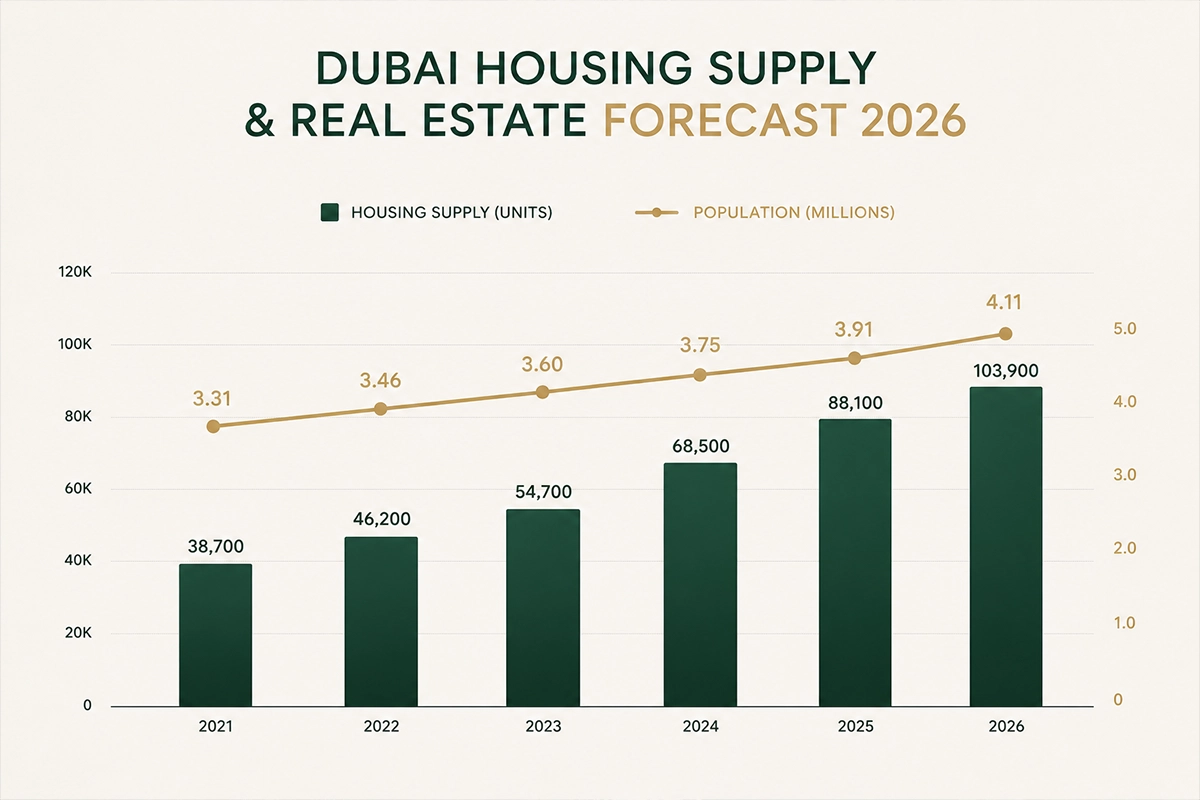
Perhaps the single most important variable influencing the Dubai real estate forecast 2026 is Dubai housing supply.
Thousands of residential units are scheduled for completion across multiple communities during the next several years.
Additional supply is not inherently negative.
Dubai requires new housing because its population continues expanding rapidly.
However, timing matters.
Some communities may receive significantly more new inventory than underlying demand can immediately absorb.
Where supply materially exceeds demand, investors should expect:
- Longer resale periods
- Increased competition
- Higher incentives from developers
- Slower capital appreciation
- Greater pressure on rental yields
Conversely, mature communities with limited land availability may continue benefiting from constrained supply.
Understanding future pipeline data is therefore just as important as evaluating current prices.
Population Growth Continues Supporting Long-Term Demand
One of Dubai’s strongest structural advantages remains population growth.
The city continues attracting:
- International executives
- Entrepreneurs
- Digital business owners
- Family offices
- Skilled professionals
- Global investors
Government initiatives supporting residency, business ownership, taxation, and wealth preservation continue reinforcing Dubai’s competitive position globally.
This expanding population supports long-term housing demand.
However, HNWI investors should avoid assuming every new resident creates equal demand across every property segment.
Luxury villas, branded residences, affordable apartments, and ultra-prime penthouses each respond differently to demographic changes.
The strongest opportunities often emerge where genuine end-user demand aligns with constrained future supply.
Where Opportunity Remains Strong
Although selectivity is becoming increasingly important, several segments continue offering attractive investment characteristics.
These generally include properties featuring:
Established Communities
Mature neighbourhoods with proven infrastructure, schools, retail, and transportation typically demonstrate stronger resilience during market transitions.
Limited Future Competition
Scarcity remains one of real estate’s strongest value drivers.
Communities with limited future development often maintain pricing power more effectively.
Premium Waterfront Assets
Luxury-quality waterfront property developments are still the strongest magnet for international HNWI investors due to their scarcity and global lifestyle appeal.
Income-Producing Assets
Properties generating stable rental income remain attractive when capital appreciation moderates.
Reliable cash flow becomes increasingly valuable during more balanced market conditions.
Where Risk May Be Increasing
Every investment cycle creates areas requiring greater caution.
The primary property correction risk does not necessarily involve the entire Dubai market declining simultaneously.
Instead, correction risk often becomes localised.
Investors should carefully evaluate projects featuring:
- Heavy future competing supply
- Aggressive launch pricing
- Limited resale demand
- Weak rental fundamentals
- Overly optimistic appreciation assumptions
Dubai property for sale purchased primarily because “Dubai property prices always go up” typically face greater downside during changing market conditions.
Disciplined underwriting remains essential.
Understanding Property Correction Risk
The phrase property correction risk frequently generates unnecessary concern.
Corrections are normal components of every property cycle.
They help restore pricing discipline.
A correction does not automatically imply market collapse.
Corrections may instead appear as:
- Slower price growth
- Flat valuations
- Increased negotiation
- Longer selling periods
- Reduced speculative activity
From an institutional perspective, these conditions often create attractive acquisition opportunities.
Investors with liquidity frequently achieve superior pricing during periods when speculative buyers become less active.
Market patience often creates investment advantage.
Best-Case Scenario for the Next 12–24 Months
In the optimistic scenario:
- Population growth exceeds expectations.
- International capital inflows remain elevated.
- Interest rates gradually stabilise.
- Luxury demand continues strengthening.
- New supply is absorbed efficiently.
Under these conditions, the Dubai property market 2026 could continue generating moderate but healthy appreciation across premium assets.
Investment performance would increasingly reward quality over quantity in real estate property in Dubai.
Base-Case Scenario
Our base-case outlook remains constructive.
Dubai’s economy continues expanding.
Population growth remains positive.
Transaction activity for Dubai property for sale stays healthy.
However:
Dubai property price appreciation becomes more moderate.
Supply creates greater differentiation between communities.
Rental growth normalises.
Premium assets outperform average developments.
This represents a healthy transition rather than market weakness.
For disciplined HNWI investors, such environments often produce superior long-term acquisition opportunities.
Downside Scenario
The downside case would likely require several factors occurring simultaneously:
- Significantly higher-than-expected housing completions
- Slower global economic growth
- Reduced foreign capital inflows
- Weaker employment expansion
- Higher financing costs
Even under this scenario, corrections would likely remain uneven.
Prime Dubai property for sale, well-located assets with genuine scarcity historically demonstrate greater resilience than speculative developments.
The city itself remains fundamentally stronger than in previous property cycles due to improved regulation, stronger banking standards, and broader economic diversification.
What Disciplined HNWI Investors Should Do Differently
As markets mature, investment discipline becomes increasingly important.
Rather than asking:
“Which project is selling fastest?”
Professional investors ask:
- Is pricing justified?
- What competing supply enters over five years?
- What drives rental demand?
- How liquid is the resale market?
- Is downside risk adequately understood?
- Does this asset improve overall portfolio quality?
These questions become increasingly valuable during a more selective market cycle.
Investors should prioritise:
- Capital preservation alongside growth
- Cash-flow resilience
- Quality over volume
- Independent market analysis
- Long-term investment horizons
Buying Dubai property for sale simply because a development offers attractive payment plans is rarely sufficient investment logic.
Dubai Investment Outlook: Long-Term Confidence with Greater Selectivity
The broader Dubai investment outlook remains compelling.
Few global cities combine:
- Political stability
- Business-friendly taxation
- International connectivity
- Strong infrastructure
- Wealth migration
- Luxury lifestyle appeal
These fundamentals continue supporting long-term demand for real estate property in Dubai.
However, HNWI investors should distinguish between confidence in Dubai and confidence in every individual project.
That distinction becomes increasingly important during the next market cycle.
The strongest portfolios are rarely built by chasing headlines.
They are built through disciplined asset selection.
Whether evaluating Dubai property for sale, comparing Dubai properties, or identifying the next property to buy in Dubai, investors should prioritise evidence over emotion.
Why Independent Advice Matters More Than Ever
One of the greatest risks investors face is receiving advice from professionals compensated primarily through transactions.
Optimism is easy during rising markets.
Independent analysis becomes most valuable when markets require nuance.
At Exior Investments, our philosophy is straightforward:
A strong city does not make every property a strong investment.
Every acquisition should be evaluated through the lens of:
- Risk-adjusted return
- Capital preservation
- Market timing
- Future supply
- Exit strategy
- Portfolio fit
This disciplined approach enables investors to navigate changing market conditions with greater confidence.
Frank’s Final Thoughts
The Dubai property market 2026 remains one of the world’s most compelling real estate markets.
Its economic fundamentals remain exceptionally strong.
Its global appeal continues expanding.
Its long-term outlook remains positive.
Yet this is also becoming a market where expertise matters more than enthusiasm.
The coming years will likely reward investors who understand the difference between owning property and owning the right property.
That distinction will define investment performance far more than broad market headlines.
Book a Confidential Market & Portfolio Briefing
Whether you are considering acquiring Dubai property for sale, reviewing existing Dubai properties, or reassessing your broader Dubai investment outlook, independent analysis can significantly improve decision-making.
Schedule a confidential paid (but refundable when you invest through us) market and portfolio briefing with Frank Vito to receive objective insight into market trends, supply dynamics, portfolio positioning, and opportunities aligned with your long-term investment strategy.
Ask Frank Quick (FAQs)
1. Is Dubai property still a good investment in 2026?
Yes, the Dubai property market 2026 continues to offer compelling opportunities for long-term investors. Dubai benefits from strong economic growth, a business-friendly environment, increasing population, and continued international capital inflows. However, not every property is positioned to outperform. Investors should focus on location, future housing supply, rental demand, and long-term fundamentals rather than relying solely on market momentum.
2. What is the Dubai real estate forecast for 2026?
The Dubai real estate forecast 2026 suggests the market is moving into a more balanced phase. While overall demand remains healthy, price growth is expected to become more selective as new developments enter the market. Premium communities with limited future supply and strong end-user demand are likely to outperform areas experiencing significant new inventory.
3. Will Dubai property prices continue to rise?
Dubai property prices are expected to remain resilient, but growth may vary significantly across different communities and property types. Prime waterfront developments, luxury villas, and well-located residential projects could continue appreciating, while areas with substantial new supply may experience slower price growth or periods of stabilisation.
4. Does increasing Dubai housing supply mean the market will decline?
Not necessarily. An increase in Dubai housing supply is a natural response to the city’s growing population and expanding economy. The impact depends on whether new supply is matched by demand. Communities receiving excessive new inventory may face increased competition and slower appreciation, while established neighbourhoods with limited future development may remain more resilient.
5. Is there a property correction risk in Dubai?
Every real estate market experiences cycles, and property correction risk is a normal part of long-term investing. A correction does not always mean falling prices across the entire market. It may instead involve slower appreciation, longer selling periods, or increased negotiation opportunities. Investors who focus on high-quality assets with strong fundamentals are generally better positioned during market adjustments.
6. What type of property should investors buy in Dubai in 2026?
The ideal property to buy in Dubai depends on your investment objectives, risk tolerance, and time horizon. Many experienced investors prioritise properties in established communities with proven rental demand, reputable developers, limited future competing supply, and strong long-term growth potential rather than simply purchasing newly launched projects.
7. What should investors consider before buying Dubai property for sale?
Before purchasing Dubai property for sale, investors should evaluate more than just the asking price. Key considerations include the developer’s track record, projected rental yield, future supply within the community, resale liquidity, service charges, infrastructure development, and exit strategy. A disciplined due diligence process can significantly improve long-term investment performance.
8. Are Dubai properties still attractive for international investors?
Yes. Dubai properties continue attracting international investors due to the emirate’s tax-efficient environment, world-class infrastructure, political stability, Golden Visa opportunities, and strategic location connecting Europe, Asia, and Africa. These factors continue supporting long-term demand for high-quality real estate property in Dubai.
9. How can investors reduce risk when investing in real estate property in Dubai?
Reducing investment risk begins with independent market analysis. Investors should diversify where appropriate, avoid purchasing based solely on marketing incentives, understand future supply pipelines, and assess whether a property’s long-term fundamentals justify its valuation. Working with experienced advisors who prioritise capital preservation over transaction volume can also help improve investment outcomes.
10. Why is independent market advice important in the Dubai investment outlook?
The Dubai investment outlook remains positive, but investment decisions should be based on objective analysis rather than market optimism alone. Independent advisors assess opportunities based on market data, future supply, pricing, rental demand, and portfolio strategy. This helps investors identify opportunities that align with their financial objectives while avoiding assets with elevated downside risk.

Frank Vito
Decade-long Dubai HNWI, Investor and Advisor