Access is not the same as alignment. A compelling opportunity can still leave key questions unanswered: how is it structured, when might capital become available, and what role would it play in the wider portfolio? For investors assessing private capital investment solutions Dubai, access alone is an incomplete measure.
Private capital advisory, deal-by-deal investment access, and structured finance serve different purposes, so broad descriptions are hard to compare. Start with your objectives, liquidity needs, and existing portfolio exposure. Then examine the opportunity’s structure, risks, and potential exit pathways. No structure removes investment risk, so discipline must remain central.
This guide explains how private capital solutions can be structured and how to evaluate their fit before committing capital. It also outlines how EXIOR Investments connects opportunity assessment, deal structure, and portfolio context through its UAE-focused private-capital and real-asset advisory work. You’ll find a practical framework for comparing approaches and considering a tailored mandate.
Key Takeaways
- Assess how the mandate, investment structure, asset exposure, and portfolio role shape a private-capital solution.
- Distinguish advisory, deal-by-deal access, structured finance, and portfolio guidance by the role each can play.
- Use objectives, time horizon, liquidity needs, risk, and portfolio fit to assess private capital investment solutions Dubai.
- Test an investment thesis against downside scenarios and dependencies, rather than relying on return assumptions alone.
- See how EXIOR Investments connects opportunity assessment, structure, and portfolio context in a tailored mandate discussion.
Private Capital Solutions in UAE: Their Purpose
Private capital solutions are tailored approaches to deploying or arranging capital outside public-market investing. Their purpose is not simply to identify an asset. They align an investment mandate with its structure, exposure, and intended role within an investor’s wider portfolio. For investors considering private capital investment solutions Dubai, this distinction turns broad service labels into a more useful decision framework.
A mandate defines the objectives and constraints guiding an approach. Structure sets out how capital is committed and the investor’s position. Asset exposure identifies what drives the investment, while portfolio role clarifies why it belongs alongside other holdings. Consider these elements together. Private capital advisory and investment access differ from property brokerage, banking, or products that promise guaranteed returns. Private investments can be complex, illiquid, and subject to capital loss.
The UAE’s investment landscape includes institutional participants such as the Emirates Investment Authority (EIA). Individual mandates operate at a different level: their design must reflect the investor’s own objectives, constraints, and portfolio context.
How private capital differs from a single investment product
A single product has defined features; a tailored solution starts with the investor’s objectives, liquidity requirements, risk tolerance, and existing exposures. The resulting mandate can guide how an opportunity is assessed and structured, but tailoring does not promise performance or remove investment risk.
Consider the same real asset in two portfolios. One investor may view it as a long-term income source; another may seek exposure to asset value growth. The underlying asset is unchanged, but the investment thesis, acceptable holding period, and portfolio purpose differ. That context should shape the assessment.
Which investors may consider a tailored mandate?
A tailored mandate may suit investors with defined objectives, meaningful capital to allocate, and a considered time horizon. It requires evaluating an investment beyond its headline appeal, including how long capital may be committed and what could affect the outcome.
Liquidity needs matter. Capital required for near-term obligations may be poorly matched to an illiquid investment. Risk tolerance matters just as much: consider potential loss, uncertainty, and concentration alongside the investment thesis. Suitability depends on individual circumstances and the relevant investment documentation. Review the structure, risks, obligations, and exit considerations before committing.
How private capital solutions combine advisory, deal access, and structuring
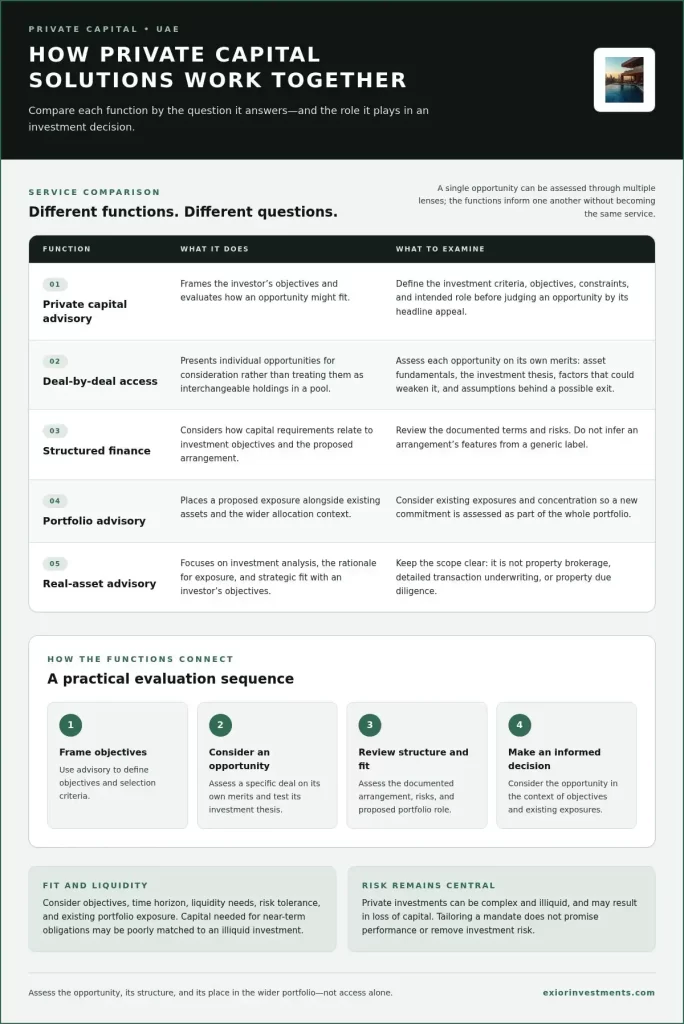
These functions answer different questions. Advisory frames the investor’s objectives and evaluates how an opportunity might fit. Deal-by-deal access presents individual opportunities for consideration rather than treating them as interchangeable holdings in a pool. Structuring considers how the capital arrangement relates to the investment objective. Portfolio advisory then places the proposed exposure alongside existing assets and concentrations.
The functions can inform one another without becoming the same service. An investor may use advisory to define selection criteria, consider a specific opportunity through deal-by-deal access, and assess its structure and portfolio role before deciding whether to proceed. For investors assessing private capital investment solutions Dubai, this sequence offers a clearer lens than comparing broad labels alone.
Real-asset advisory focuses on investment analysis and strategic fit, not property brokerage. It considers the rationale for exposure and how it relates to an investor’s objectives. It is distinct from detailed transaction underwriting or property due diligence. For broader context on a federal institution’s role in the UAE capital landscape, the official EIA website is a useful reference. Its institutional mandate is different from an individual investor’s tailored mandate.
Deal-by-deal access and real-asset advisory
Assess each opportunity on its own merits. Consider the asset fundamentals, the investment thesis, factors that could weaken it, and assumptions behind a possible exit. Then define the role the exposure would serve: income, growth, diversification, or another objective. These are analytical questions, not assurances of outcome. Account for uncertainty around the holding period and the possibility that exit assumptions may not be achieved.
Structured finance and portfolio advisory
Structured finance considers how capital requirements relate to investment objectives and the proposed arrangement. Assess the structure against its documented terms and risks, rather than inferring its features from a generic label. Portfolio advisory takes a broader view, considering existing exposures, concentration, and allocation context so a new commitment is assessed as part of the whole portfolio.
EXIOR Investments provides private-capital and real-asset advisory, deal-by-deal access, structured finance, and portfolio advisory. A focused discussion can begin with the investment objective, the opportunity under consideration, and its intended role in the portfolio. Explore EXIOR Investments’ private-capital and real-asset advisory.
How to assess a private capital investment solution before Committing
Access is only one part of the decision. Before committing, test whether the mandate fits your objectives, whether you can accommodate its liquidity profile, and whether its risks make sense within your portfolio. An Emirates News Agency report describes the UAE as a leading private capital market, but market momentum alone doesn’t prove a particular opportunity is suitable for you.
Five questions that clarify mandate fit
Use these questions to move from an attractive thesis to a considered decision:
- Objective: What specific investment objective should the mandate address, and what role should it play in your portfolio?
- Time horizon: How long can capital remain committed, and does that period align with your wider plans?
- Liquidity: Could you meet foreseeable cash needs if capital cannot be accessed when expected? Treat any proposed exit timing as an assumption, not a certainty.
- Risk and dependencies: What conditions must hold for the thesis to work? Consider downside scenarios, execution challenges, and factors outside your control, as well as the possibility of losing capital.
- Portfolio fit: How would the exposure affect existing asset, sector, and counterparty concentrations? A new investment may add exposure without meaningfully diversifying the portfolio.
Keep the investment thesis separate from return assumptions. The thesis explains why an opportunity may create value; assumptions about timing, growth, or exit describe possible outcomes, not promises. Test how the case changes if key dependencies weaken or the exit takes longer than anticipated.
Structure, documentation, and risk review
Review the proposed legal structure, decision rights, reporting approach, and key investment documentation. Clarify who holds which responsibilities, how material decisions are made, what information investors receive, and which terms govern commitments and exits. Understand the documents before committing capital, rather than treating them as administrative detail.
Jurisdiction-specific legal and tax considerations can affect how a structure operates and should be assessed with qualified advisers. Due diligence means reviewing the investment thesis, structure, risks, documentation, and portfolio fit, including the assumptions and dependencies that could alter the outcome.
For investors considering private capital investment solutions Dubai, the standard is not certainty. It is clarity on what must go right, what could go wrong, and whether the exposure remains appropriate within the investor’s wider circumstances.
Matching a UAE private capital approach to investment objectives
The right approach depends on the question an investor needs to answer. Is the priority to assess a specific opportunity, understand real-asset exposure, consider how capital is arranged, or review an allocation across the wider portfolio? These approaches can complement one another, but they are not interchangeable. The comparison below is a starting point, not a recommendation.
When deal-by-deal access may suit the mandate
Deal-by-deal access may suit an investor who wants to assess individual opportunities against a defined investment thesis rather than consider an undifferentiated pool. For example, an investor with a specific real-asset objective could examine how one opportunity’s fundamentals and risks compare with that objective. This is an illustration, not a recommendation. Access does not remove investment risk or ensure an allocation. Illiquidity, concentration, execution, and transaction-specific risks still require careful consideration.
When advisory or structuring may be the priority
If objectives and constraints need sharper definition, advisory can help establish the investment architecture before an opportunity is selected. Structured finance may be relevant when the relationship between capital requirements and the mandate is central. Portfolio advisory takes a broader view, examining exposures and strategic fit rather than treating each deal in isolation.
For investors evaluating private capital investment solutions Dubai, the useful question is which need comes first, not which approach is universally superior. EXIOR Investments connects private-capital and real-asset advisory with deal access, structured finance, and portfolio context. Learn about EXIOR Investments’ advisory services.
EXIOR Investments: a tailored route from investment thesis to next steps
A private-capital mandate should begin with the investor’s context, not a catalog of opportunities. EXIOR Investments offers private-capital and real-asset advisory, deal-by-deal investment access, structured finance, and portfolio advisory, with a focus on the UAE market. The aim is to connect an investment thesis with a careful assessment of opportunity, structure, and portfolio role.
Different needs call for different work. An investor seeking exposure to an individual opportunity may focus on deal-by-deal access and its specific risks. A mandate centered on capital requirements may place greater emphasis on structuring. When the question is how a proposed investment relates to existing holdings, portfolio advisory can bring exposures and allocation context into the discussion. These are distinct considerations, and none removes investment risk.
For investors exploring private capital investment solutions Dubai, a focused discussion can help clarify which question deserves attention before a decision is made.
What a focused investment discussion should establish
A useful discussion shapes the mandate by establishing the investor’s objectives, time horizon, liquidity requirements, and risk considerations. It should also identify the priority: access to individual opportunities, real-asset analysis, capital structuring, or a broader view of portfolio exposures. These answers provide a basis for assessing fit rather than assuming one approach suits every investor.
Relevant investment information and documentation then need careful review. Before deciding whether to proceed, understand the thesis, structure, material risks, responsibilities, and potential exit considerations. A discussion can frame the assessment; it cannot replace a considered review of the specific opportunity and its documentation.
A measured next step with EXIOR Investments
For investors considering a mandate, a discreet conversation about capital objectives and mandate fit can help focus the next steps. A clear account of investment priorities, time horizon, liquidity constraints, and existing portfolio context helps keep the exchange specific. The discussion can consider whether deal access, real-asset advisory, structured finance, portfolio advisory, or a combination best addresses the mandate.
Shape Your Next Capital Decision with Discipline
A considered private-capital approach begins with alignment: the mandate, structure, and portfolio role should support the investor’s objectives. Before committing, assess liquidity needs, time horizon, concentration, downside scenarios, and the opportunity’s documentation. Access can broaden consideration, but it cannot remove risk or replace careful diligence.
For investors evaluating private capital investment solutions Dubai, EXIOR Investments offers deal-by-deal investment access and a focus on UAE real assets and private-capital advisory. Its work also includes structured finance and portfolio advisory, linking opportunity assessment to capital structure and broader portfolio context.
Frequently Asked Questions